Character Archetypes & Craft
The Magician: The Archetype of Transformation
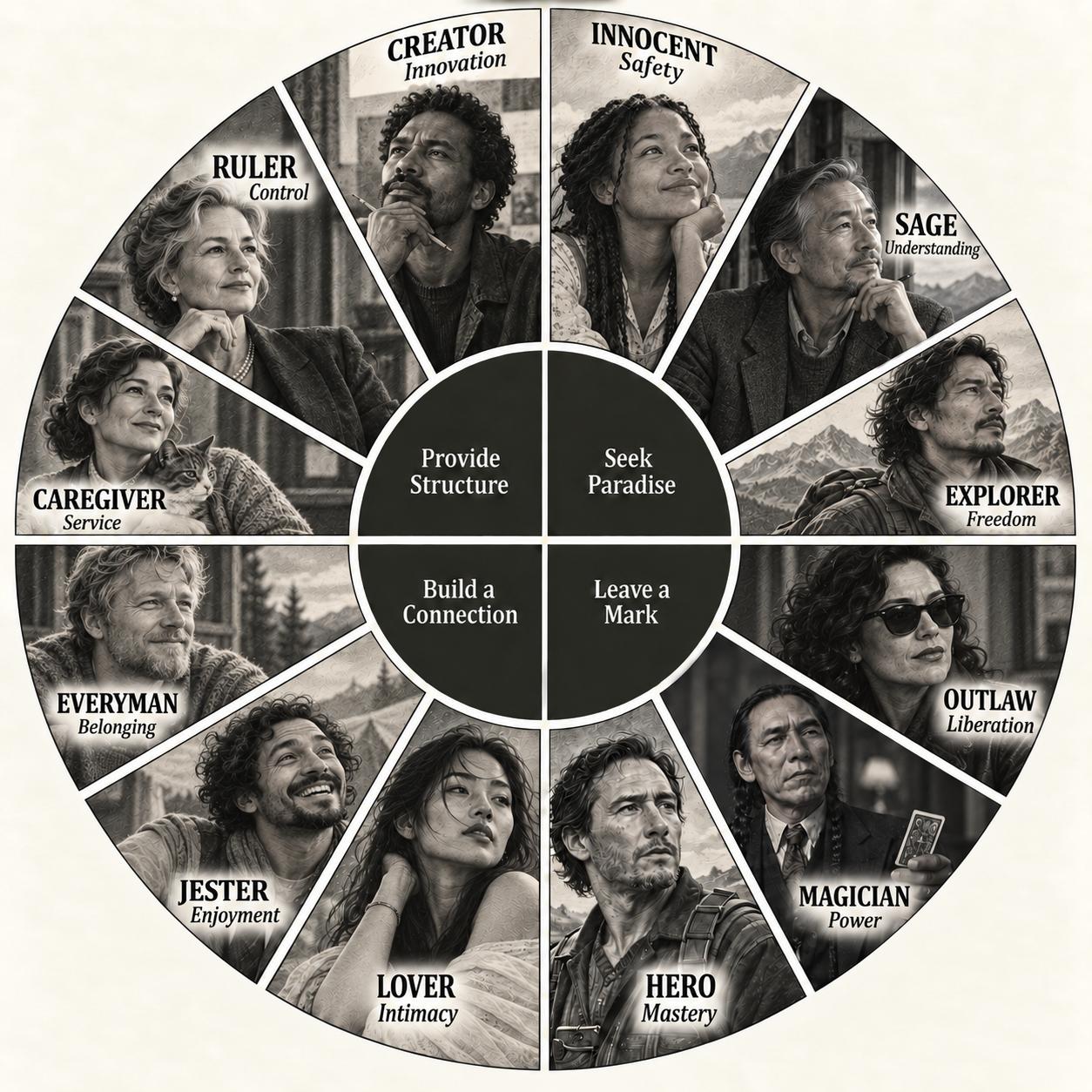
The Archetype of Transformation
The Magician is the archetype of transformation. He is not defined by spells, supernatural power, or even unusual intelligence, but by the ability to recognize patterns, understand hidden systems, and use that knowledge to change what is possible. The Magician may be a wizard, but he may just as easily be a scientist, strategist, healer, inventor, philosopher, or con artist. What matters is not that he knows more than other people. It is that he knows how to make knowledge operative.
The Magician's strength is his ability to see patterns and possibilities that others miss. But this can also isolate him. It is difficult to find a peer when few people see the same connections, and the Magician may find himself surrounded by friends without finding anyone who can reciprocate. His ability to understand others does not necessarily mean that they understand him. At his worst, that isolation becomes loneliness: he may begin to doubt whether anyone can truly meet him where he is. At best, he becomes a mentor who finds a partner on a different stage of the same journey, not merely a sounding board for his own hubris.
In a story, the Magician is often the character who changes the terms of what is possible. He may introduce a new method, reveal a hidden pattern, or reinterpret what everyone else has taken for granted. His role is not simply to provide answers, but to alter the framework through which the other characters understand problems or derive meaning from events or situations. Once the Magician sees the mechanism, the story can move in a direction that was previously invisible.
Origins of the Magician
The Magician entered literature long before anyone called him an archetype. Early versions were figures whose specialized knowledge placed them somewhere between the natural and supernatural worlds.
Merlin is one of the clearest medieval examples. Geoffrey of Monmouth's twelfth-century Merlin was not originally the elderly wizard of modern fantasy. He was a prophet-magician associated with astrology, cosmology, natural magic, and knowledge unavailable to kings themselves. His importance came partly from his ability to interpret forces other people could not see and decide when—or whether—to reveal what he knew.
By the Renaissance, however, the learned Magician became increasingly dangerous—not only as a literary figure, but as a real-world accusation. Across Europe, people accused of witchcraft were imprisoned, tortured, and burned, and many witches died because their knowledge, healing practices, or independence placed them outside accepted religious and social authority. No other archetype has been more persistently persecuted: the Magician's defining relationship with hidden knowledge has repeatedly made the figure a target for institutions threatened by what cannot be controlled. The period's fear of forbidden knowledge also shaped the fate of Giordano Bruno, the Italian philosopher and former Dominican friar. In 1600, Bruno was burned at the stake in Rome. The Magician was no longer merely the wise adviser standing beside the king. He had become the person who could be treated as a threat to the entire order of society.
Even figures who were not persecuted as heretics often kept their deepest interests hidden. Isaac Newton, remembered as the founder of modern physics, devoted enormous energy to alchemy, which he largely concealed from public view because it did not fit the image of the rational scientist. Secret societies later intensified this association between hidden knowledge and danger, especially through figures such as Aleister Crowley, whose ceremonial magic and public reputation helped cement the popular connection between the Magician, forbidden practices, and evil.
This history has profoundly influenced literature. Medieval and early-modern writers often mocked him as a fraud or fool chasing impossible transmutations, but the literary figure gradually changed as well. By the modern period, the alchemist could represent someone trying to change lead into gold, but transformation became the domain of scientists, and any scientist who strayed from materialist conventions was dubbed a mad scientist.
That evolution matters because it brings the literary Magician surprisingly close to the scientist. Both begin with the conviction that hidden processes can be understood. Both develop methods for revealing them. And both eventually confront the same question: once you understand how something works, what are you willing to do with that knowledge?
Frankenstein: The Scientist as Magician
Victor Frankenstein is one of literature's clearest examples of the scientist as Magician. He is not satisfied with observing life or describing its mechanisms.
Frankenstein's defining act is not discovery but application. He gathers information, identifies a method, and uses it to alter the most fundamental condition he can imagine: the difference between living and dead matter.
His failure is also distinctly Magician-like. Victor understands enough to act, but not enough to foresee what his action will require of him afterward. He mistakes the ability to produce a result for mastery over its consequences.
The experiment transforms more than the creature. It transforms Victor's identity, his relationships, and ultimately the structure of his life. The knowledge he pursued does not simply give him power. It creates obligations he is unable—or unwilling—to meet.
This is one of the central tensions of the Magician archetype. The question is rarely whether transformation is possible. The more dangerous question is what happens after it succeeds.
Why Writers Misunderstand the Magician
Of the many ways writers misunderstand the Magician, the most fundamental mistake is the assumed motive. Magicians are often sorted into good and evil according to what they do with their power, as if morality itself defines the archetype. But good and evil are almost never the Magician's motive.
Dumbledore starts out selfless and powerful, but his later arc reveals calculated choices that complicate his character. He manipulates events, withholds information, and makes decisions for other people because he believes he understands the larger pattern. In Back to the Future, Doc can make mistakes, but his unwavering commitment to science neutralizes some of his more questionable choices. He steals plutonium from Libyan nationalists after agreeing to build them a nuclear weapon, all so he can power his time machine.
The Magician can be benevolent, selfish, reckless, or cruel. What drives him is the pursuit and application of knowledge: understanding how something works well enough to transform it. Good and evil describe what he chooses to do with that power, not why he sought it in the first place.
The Magician and Inner Alchemy
When I first started writing The Bright Dark, I thought my character needed a classic Hero's Journey template to follow, but Ren wasn't a hero or an antihero. He was an inexperienced academic who was going to learn inner alchemy—he was a Magician.
Arguably a more powerful character than the Hero, the Magician isn't typically the protagonist, because his transformation happens in his inner world. His arc is less visible than the Hero's. It happens through changes in perception, understanding, identity, and his relationship to knowledge and power.
But even if we don't have a clear template for the Magician in literature, history provides numerous metaphors for becoming an alchemist.
In the ancient world, the Corpus Hermeticum described the process using the planets as stages of inner transformation. In medieval times, alchemists used stages of metallurgy to represent the purification of their inner selves. Gnostics and various religious movements all had their own spin on becoming a shaman, a scientist, an alchemist, or a magician.
Some traditions believed the process started with an awakening; others endured a long dark night of the soul.
Ren's transformation follows this pattern through a series of changes in identity. He begins with identities that seem solid: academic, Guardsman, Aucklander, son, brother, rational observer. But the journey repeatedly complicates or strips away his certainty about what those identities mean. Even the distinction between observer and participant becomes harder to maintain. By the time Ren begins to understand what is happening around him, the person doing the understanding is no longer quite the person who set out to find the answers.
The alchemical journey strips the Magician of certainty. At the same time, he learns to read patterns and apply methods rather than simply accumulate information.
The word knowledge comes through Old English cnāwleċe, from the same root as know: not merely possessing information, but apprehending, recognizing, or understanding something. That distinction matters for the Magician. Information can be collected; knowledge can be used.
Knowledge is power.
Iconic Magicians
Sherlock Holmes is regularly classified as a Sage, but his knowledge is less important than his method, which is distinctly Magician-like. Holmes collects ordinary information and turns it into knowledge through pattern recognition. A scuff on a shoe, a particular kind of ash, or an apparently irrelevant choice of words becomes meaningful. To everyone else, his conclusions can appear almost supernatural.
Paul Atreides in Dune operates on a much larger scale. He learns to read political, religious, ecological, and human systems at the same time, then discovers that understanding those systems gives him the ability to manipulate them. The tragedy is that seeing the pattern does not necessarily mean he can escape it.
Hannibal Lecter represents a darker form of the Magician. His medium is other people. He recognizes fears, desires, insecurities, and contradictions, then uses that knowledge to alter behavior. He rarely needs physical force when a few carefully chosen words can change what someone believes or what they will do next.
None of these characters needs the traditional robes and wand. What makes them Magicians is their ability to perceive a hidden structure and act upon it. Their magic lies in the distance between what everyone else sees and what they know can be done.
The Shadow of the Magician
A person without peers has fewer opportunities to be corrected. The darker version of the Magician archetype does not necessarily become evil; he becomes convinced that understanding gives him authority. His power can be creative or destructive, but he is neither good nor bad—he is human.
Writing the Magician
Not every protagonist needs a Hero's Journey. A Magician can be the main character and cross the same distance without conquering anything. His victories should reveal new problems rather than close them. The Magician's journey should be one of self-discovery, an ever-widening landscape of limitations on knowledge and power.
I lean on the same instinct with Ren in The Bright Dark. His transformation isn't measured in battles won, but in how much less certain he becomes about who he was before he understood what he now understands.